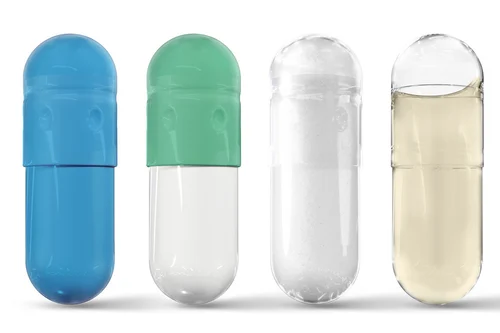
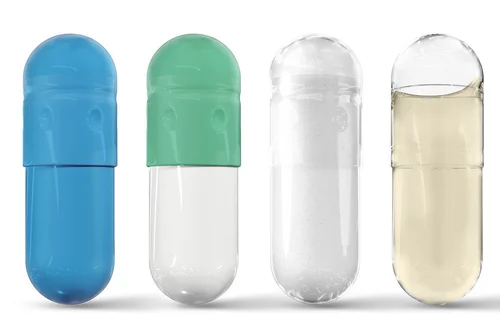
Liquid-filled hard capsules (LFHCs) combine advanced formulation approaches with precisely controlled manufacturing processes. While accurate filling ensures dose uniformity, sealing is the defining step that determines capsule integrity, stability, and patient safety.
Explore advanced capsule filling and sealing solutions.
1. Capsule Shell Selection
Manufacturing begins with selecting an appropriate capsule shell material—most commonly gelatin or plant-based polymers such as HPMC or pullulan. Shell choice influences:
- Moisture and oxygen barrier properties
- Compatibility with lipid-based or hygroscopic fills
- Thermal behavior during sealing
- Regulatory and patient acceptance considerations
Plant-based shells are increasingly used in both industrial and pharmacy settings due to their compatibility with lipid systems and predictable sealing behavior (Uttreja et al., 2025; Podczeck & Jones, 2004).
2. Filling Accuracy and Environmental Control
Liquid or semi-solid formulations are dosed using volumetric or gravimetric systems designed for high reproducibility. For oxidation-sensitive formulations, controlled environments and nitrogen purging are frequently applied to minimize oxygen exposure during filling (Waterman & Adami, 2005; ICH, 2003).
However, precise filling alone does not guarantee product performance. Without effective sealing, filled capsules remain vulnerable to leakage, oxidation, and contamination.
3. Why Sealing Is Critical
Sealing transforms a filled capsule into a finished dosage form capable of withstanding handling, transport, and storage. Poor sealing can result in:
- Leakage or evaporation
- Oxygen and moisture ingress
- Reduced shelf life and dose variability
- Compromised tamper evidence
As such, sealing is a core quality determinant in LFHC manufacturing.
4. Sealing Technologies: Fusion Sealing, LEMS® technology vs. Banding
Three main approaches are used in pharmaceutical manufacturing:
Fusion Sealing
Fusion sealing applies a hydroalcoholic or aqueous solution to the capsule seam, followed by controlled heat and pressure to fuse the cap and body into a continuous structure.
Advantages include:
- Integrated, tamper-resistant seals
- No additional materials or components
- High reproducibility and throughput
- Enhanced resistance to environmental stress
Fusion-sealed capsules demonstrate low oxygen permeability and strong mechanical integrity, particularly when combined with nitrogen purging (Woo et al., 2023; Szweda et al., 2024).
LEMS® Technology (Liquid Encapsulation Microspray Sealing)
LEMS® technology is an enhanced sealing method in which a fine microspray of sealing fluid is applied to the capsule seam, followed by gentle heating to fuse the cap and body into a continuous closure.
Reported advantages include:
- Larger sealed area compared with traditional banding, which can improve structural integrity and reduce leakage risk (NutraIngredients, 2007)
- Elimination of external banding, resulting in a continuous cap–body interface (Pharmaceutical Online, 2007a)
- Demonstrated integrity in stability testing, with capsules remaining leak-free under extended storage conditions (Pharmaceutical Online, 2007b)
LEMS® technology is particularly beneficial for lipid-based, oxidation-sensitive, or otherwise formulation-challenging fills, providing reproducible sealing while maintaining product stability.
Banding
Banding involves applying a polymer solution or band around the capsule seam after filling. Common banding materials include gelatin or polysaccharide-based polymers. Banding has been shown to improve leakage resistance and tamper evidence; however, published studies highlight potential limitations:
- Additional processing steps and drying time
- Variability in band thickness and appearance
- Compatibility constraints with certain shell polymers
Comparative evaluations indicate that while banding improves leakage resistance and tamper evidence, fusion sealing and LEMS® technology generally provides superior seam integrity and process efficiency for liquid-filled applications (Jones & Podczeck, 2001; Podczeck & Jones, 2004).
5. Impact on Stability, Safety, and Compliance
Sealing performance directly affects stability outcomes. Fusion-sealed LFHCs have demonstrated strong performance in accelerated stability studies for hygroscopic and oxidation-sensitive formulations (Woo et al., 2023; Waterman & Adami, 2005; ICH, 2003). From a regulatory and patient-safety perspective, tamper-evident sealing improves confidence in dose integrity and reduces manipulation risk.
Conclusion
In liquid-filled capsule manufacturing, sealing is not a secondary step—it is foundational to quality, stability, and patient safety. Understanding sealing technologies, including LEMS® technology, enables formulators to select appropriate manufacturing strategies aligned with formulation sensitivity and lifecycle requirements.
In the next article, we explore why formulators and pharmacies alike are increasingly adopting in-house liquid capsule filling solutions: Why Compouding Pharmacies Are Turning to In-House Capsule Filling Solutions
References:
- Capsugel. (n.d.). Licaps® Fusion Technology Overview.
- Capsugel. (n.d.). CFS 1200® Capsule Filling and Sealing Machine Specifications.
- Holm, R., Kuentz, M., Ilie-Spiridon, A.-R., & Griffin, B. T. (2023). Lipid-based formulations as supersaturating oral delivery systems: From current to future industrial applications. European Journal of Pharmaceutical Sciences, 189, 106556.
- Woo, S.-w., Hwang, S.-J., & Cho, C.-W. (2023). Liquid-filled hard capsule formulation of choline alfoscerate: In vitro/in vivo evaluation and bioequivalence to softgels. Journal of Pharmaceutical Investigation, 53(4), 517–526.
- Szweda, N. M., Rapin, M. N., Evans, P., Braun, S., & Hacker, M. C. (2024). Carrageenan-based solutions for the sealing of liquid-filled pullulan hard capsules. PBP World Meeting.
- Podczeck, F., & Jones, B. E. (2004). The sealing of hard gelatin capsules. International Journal of Pharmaceutics, 274(1–2), 1–12.
- Jones, B. E., & Podczeck, F. (2001). Evaluation of the sealing performance of banded hard gelatin capsules. Pharmaceutical Development and Technology, 6(3), 359–371
- Rowe, R. C., Sheskey, P. J., & Quinn, M. E. (Eds.). (2012). Handbook of pharmaceutical excipients (7th ed.). Pharmaceutical Press.
- Waterman, K. C., & Adami, R. C. (2005). Accelerated aging: Prediction of chemical stability of pharmaceuticals. International Journal of Pharmaceutics, 293(1–2), 101–125.
- ICH. (2003). Q1A(R2): Stability testing of new drug substances and products. International Council for Harmonisation.
- Uttreja, P., Karnik, I., Youssef, A. A. A., et al. (2025). Self-emulsifying drug delivery systems (SEDDS): Transition from liquid to solid—A comprehensive review. Pharmaceutics, 17(1), 63.
- Industry best practices for nitrogen purging in pharmaceutical manufacturing. (n.d.). Retrieved December 23, 2025.
- NutraIngredients. (2007, June 25). Capsugel says new Licap suited to supplements. NutraIngredients. https://www.nutraingredients.com/Article/2007/06/25/capsugel-says-new-licap-suited-to-supplements
- Pharmaceutical Online. (2007a). Licaps capsules. Pharmaceutical Online. https://www.pharmaceuticalonline.com/doc/licaps-capsules-0001
- Pharmaceutical Online. (2007b). Allows rapid in-house manufacture of capsules. Pharmaceutical Online. https://www.pharmaceuticalonline.com/doc/allows-rapid-in-house-manufacture-of-capsules-0001